Affiliate Disclosure: We may earn a small commission if you click links and make a purchase. This article is for informational purposes only and does not constitute financial advice.
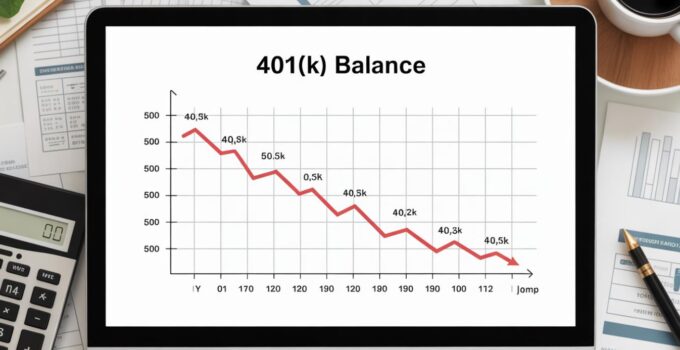
Seeing a shrinking 401(k) balance can feel like watching your house value fall every time you check Zillow. It’s gut-punch stuff.
The natural thought is, “If I’m throwing good money after bad, maybe I should stop contributing.”
Sometimes pausing does make sense—but most of the time, turning off contributions hurts more than it helps.
This guide gives you a clear, step-by-step framework to decide what to do right now. You’ll learn why balances drop, when a pause is reasonable, when it’s costly, and how to adjust contributions and investments without torpedoing your long-term plan.

TL;DR (What most people should do)
-
Don’t stop contributions if you get an employer match. That match is an immediate, risk-free return you can’t replace elsewhere.
-
Down markets are on sale. Consistent contributions buy more shares at lower prices (dollar-cost averaging), which often speeds recovery.
-
Do consider a temporary adjustment if you’re carrying high-interest debt, have no emergency fund, or you’re over-exposed to risk for your time horizon.
-
Fix the root causes: fees, asset mix, and savings rate—rather than reflexively shutting the faucet off.
-
If you pause, set a clear restart date or auto-resume rule so a short break doesn’t become a lost decade.
Why your 401(k) is “losing money” (and why that phrase misleads)
“Losing money” usually means the market value is down, not that your contributions vanished. 401(k) balances fluctuate with:
-
Stock and bond price moves. Both can fall at the same time (e.g., when interest rates rise quickly).
-
Your asset mix. A stock-heavy portfolio swings more; bond-heavy swings less but can still dip.
-
Fees. High expense ratios or plan admin costs drag returns every year, win or lose.
-
Behavior. Chasing last year’s winner or panic-selling at lows cements losses that paper declines alone would not.
Important: Declines are unrealized unless you sell. New contributions after a drop are often your best-priced dollars of the decade.
The case for continuing contributions (even when it hurts)
1) Employer match = free money you can’t replace
If your company matches, say, 50¢ per $1 up to a limit, you’re getting an instant 50% return on those dollars before markets even move. Skipping the match is like refusing a raise.
Action: At a minimum, contribute enough to capture the full match before you consider any pause.
2) Dollar-cost averaging (DCA) quietly boosts your future
When prices fall, your fixed contribution buys more shares. When they rise, you own more—and those shares compound. Pulling contributions during a slide is like skipping the sale and returning only after prices rise.
Mental model: You’re not pouring money into a hole; you’re buying inventory at a discount.
3) Markets recover more often—and faster—than headlines suggest
History doesn’t repeat on a schedule, but it rhymes. Market drops are frequent; recoveries tend to be longer and occur when sentiment is bleak. If you stop adding during the bleak phase, you miss the phase that usually lays the foundation for the next leg up.
4) Tax benefits work best with consistency
Traditional 401(k) deferrals reduce taxable income now (Roth contributions grow tax-free later). Both benefits compound over time. Pausing contributions forfeits today’s tax break (traditional) or tomorrow’s tax-free growth (Roth).
When a temporary pause (or reduction) can make sense
Not every “keep contributing” mantra fits every household. Consider a short pause (or a reduced contribution) if:
-
You have no emergency fund.
If a single expense would force high-interest credit card debt, shore up 3–6 months of expenses first. A small 401(k) contribution cut for a few months to build cash can reduce the odds of a forced withdrawal (and penalties) later. -
You’re paying double-digit interest debt.
If your credit card APR is 20%+, the guaranteed “return” from eliminating that debt typically beats expected market returns—even with compounding. But still contribute enough to get the match if you can. -
You’re unintentionally over-risked for your time horizon.
If you’re within a few years of retirement and sitting 90% in stocks because no one ever rebalanced, address the allocation first. A small contribution pause while you rebalance and revisit risk might be prudent. -
You’re facing a short-term cash crunch (medical bill, job transition).
If cash flow is temporarily tight, a time-boxed reduction can help you avoid loans or withdrawals.
Key rule: If you pause, set a restart date (e.g., 90 days) or a trigger (“resume when credit card balance is <$1,000”). Put it in writing or a calendar event so the pause doesn’t linger.
A step-by-step decision flow (use this today)
-
Do you get a match?
-
Yes: Contribute at least to the full match.
-
No: Go to step 2.
-
-
Do you have high-interest debt (>10–12%) or zero emergency fund?
-
Yes: Consider reducing contributions (not eliminating) while you:
-
Build $1,000–$2,500 starter fund, then 3–6 months, and
-
Attack high-interest balances.
-
Keep at least a token 401(k) contribution so restarting is easy.
-
-
No: Go to step 3.
-
-
Is your asset mix wildly off from your time horizon?
-
Yes: Rebalance to an age-appropriate mix (see examples below). Continue contributing.
-
No: Go to step 4.
-
-
Are plan fees unusually high or choices very limited?
-
Yes: Contribute to match; redirect the rest to a low-cost IRA (if eligible) or HSA for medical savings.
-
No: Keep contributing; consider raising the rate by 1%—especially during downturns.
-
Fix the root causes (this matters more than “stop or go”)
1) Right-size the asset allocation
Use age, time horizon, and “sleep-at-night factor” to frame your mix. Examples (illustrative, not advice):
-
Under 40, long horizon: 80–95% stock funds, 5–20% bonds/stable value.
-
Age 40–55: 65–85% stocks, 15–35% bonds/stable value.
-
Within 10 years of retirement: 45–65% stocks, 35–55% bonds/stable value.
-
In retirement drawdown: 30–50% stocks, 50–70% bonds/stable value/cash ladder.
If your plan offers target-date funds, check fees and glide path; they can be a one-decision solution if you prefer simplicity.
2) Lower your all-in fees
-
Prefer index funds with low expense ratios for U.S. stocks, international stocks, and bonds.
-
Compare plan admin costs. If your plan is expensive, contribute to the match, then fund a low-cost IRA for additional savings (subject to eligibility and IRS limits).
3) Automate rebalancing
Once or twice per year, rebalance to your targets. This forces you to sell a bit of what ran and buy what lagged, which is the opposite of panic behavior.
4) Consider Roth vs. Traditional contributions
-
Traditional 401(k): Lowers taxable income now; withdrawals taxed later. Often helpful in high tax years.
-
Roth 401(k): No current deduction; qualified withdrawals tax-free later. Useful if you expect higher taxes later or value tax diversification.
You can split contributions if your plan allows—e.g., 50% traditional, 50% Roth—to hedge tax-rate uncertainty.
5) Understand vesting and match rules
If you’re considering leaving your employer, know match vesting schedules. Pausing contributions right before a vesting milestone can be an expensive timing mistake.
“But my account is down 15%. Isn’t stopping common sense?”
It feels that way. But consider three counterintuitive truths:
-
Your future dollars just got stronger.
New contributions buy more shares at cheaper prices—like buying more house when the market dips instead of when it spikes. -
The worst days and the best days cluster.
Many of the market’s biggest up days occur near big down days. If you’re out (or not buying) during that window, your recovery often lags for years. -
Time in the market usually beats timing the market.
Even pros struggle to pick bottoms. A simple, steady savings plan with periodic rebalancing tends to beat emotional toggling from “all in” to “all out.”
Special situations (and what to do)
Close to retirement (within 5–10 years)
-
Sequence of returns risk matters: bad early-retirement years hurt more.
-
Solutions:
-
Shift part of the portfolio to short-duration bonds/TIPS/stable value to support the first few years of withdrawals.
-
Keep some stock exposure for growth; too little invites inflation risk.
-
Consider a bond/cash “spending bucket” equal to 2–5 years of planned withdrawals, refilled periodically.
-
Stopping contributions entirely right before retirement usually slows the recovery of your cushion; trimming risk and rebalancing are more targeted fixes.
High-fee 401(k) plan
-
Contribute to grab the match.
-
Direct extra savings to a low-cost IRA (Traditional or Roth, subject to eligibility) or an HSA (if you have a high-deductible health plan).
-
If allowed, use a brokerage window inside the 401(k) to access low-cost index funds (mind any extra fees).
Job insecurity
-
Build liquidity first (cash cushion), then keep at least a small 401(k) contribution.
-
Avoid 401(k) loans if possible; job loss can trigger rapid repayment or a taxable distribution.
Large 401(k) loan already outstanding
-
Prioritize repayment—but don’t skip the match unless absolutely necessary.
-
If job change is likely, know the loan-repayment rules to avoid unintended taxes/penalties.
How much should you contribute right now?
A helpful rule of thumb:
-
Minimum: Enough to capture the full employer match—even in tough times.
-
Good target: Total retirement savings of ~15% of gross income across accounts (401(k)/IRA/HSA), increasing by 1% per year until you get there.
-
Catch-up years: If you’re behind, raise contributions by 2–3% annually or whenever you get a raise, bonus, or paid-off debt.
If you’re pausing or reducing contributions for a specific reason (debt, emergency fund), write the restart rule now:
“Resume my prior 401(k) rate on [Date] or when [Debt/Goal] hits [Target]—whichever comes first.”
Then set a calendar reminder or automation with HR/payroll.
What if markets keep falling?
Build a pre-commitment plan that removes guesswork:
-
“I keep contributing at X%.”
-
“If my stock allocation rises/falls 5–10 percentage points from target, I rebalance back.”
-
“If markets fall an additional 10%, I increase contributions by 1% (if cash flow allows).”
-
“If my emergency fund dips below 3 months, I reduce contributions (but keep the match) until it’s back above 3 months.”
This turns a scary headline into a list of if-then statements you control.
A 10-minute annual checkup (print this)
-
Contribution rate: Are you at the match? Can you bump by 1%?
-
Asset mix: Still appropriate for your age and timeline?
-
Fees: Using low-cost index funds where possible?
-
Rebalance: Are you inside your target bands (e.g., ±5 percentage points)?
-
Savings priority order:
-
Capture 401(k) match
-
Build emergency fund
-
Pay high-interest debt
-
Max HSA (if available)
-
Max IRA (if eligible)
-
Increase 401(k) toward your target
-
-
Tax mix: Consider splitting Roth/Traditional for flexibility.
-
Restart rules: If you paused, is the auto-resume set?
Scenario snapshots (to make this concrete)
Scenario 1: Age 32, balance down 18%, has match
-
Do not stop: Keep at least the match.
-
If no emergency fund, temporarily reduce above-match contributions and build $2,000–$5,000 cash.
-
Move to a low-cost target-date fund or a simple 3-fund index mix; set rebalance bands.
Scenario 2: Age 51, balance down 14%, retiring in 10–12 years
-
Review allocation: perhaps 65–75% stocks / 25–35% bonds/stable value (illustrative).
-
Keep contributing—in fact, consider catch-up contributions if permitted.
-
Start a bond/cash sleeve you’ll later convert to a 2–3-year spending bucket.
Scenario 3: Age 58, retiring in 5 years, anxious about sequence risk
-
Shift enough into short-duration bonds/stable value to cover your first 3–5 years of expected withdrawals.
-
Maintain some equity for growth.
-
Don’t stop contributing (especially if you have a match); but contributions above the match could go to Roth IRA/HSA for tax diversification if eligible.
Common myths (and better replacements)
-
Myth: “Stopping now avoids more losses.”
Better: Stopping now prevents buying cheaper shares and often locks in a higher average cost. -
Myth: “I’ll wait until the market stabilizes.”
Better: Stabilization is only obvious in hindsight. Automatic contributions remove the guesswork. -
Myth: “Bonds always go up when stocks go down.”
Better: Not always—especially during fast rate-hike cycles. Use shorter-duration bonds and cash-like funds to reduce interest-rate risk. -
Myth: “Target-date funds are ‘set and forget’ forever.”
Better: They’re convenient, but review fees and glide path; sometimes simple index funds cost less.
A calm answer to your original question
“My 401(k) is losing money—should I stop contributing?”
In most cases, no—especially not below the employer-match threshold. Market drawdowns feel awful, but for savers still building wealth, they’re usually the best time to keep buying. A temporary reduction can be justified to build an emergency fund or crush high-interest debt, but the default should be keep going, fix your asset mix and fees, and set clear rules so you never have to improvise during a scary headline.
Think of contributions as future you buying income. Down markets sell that income at a discount. If you keep buying through the uncomfortable patches, you give future you the raise you’ll be glad you didn’t skip.
Disclaimer: This article is for education and general information only—not financial, tax, or legal advice. Markets, rules, and contribution limits can change quickly. Always do your own research and consider consulting a qualified professional before making decisions. You’re responsible for your choices and outcomes.